
Agropharm, a corporate website in five languages migrated from WordPress without losing a single URL or the organic traffic that sustains it
Agropharm is a Spain-based agricultural and industrial engineering firm that designs, licenses, builds and certifies GACP/GMP facilities: medical cannabis as its speciality, plus industrial hemp, substrates, recycling, water and waste.
Where we started
Agropharm's website ran on WordPress with Divi and lived off search: more than eight in ten visits came from Google, almost all of them to a handful of blog articles. Rebuilding it carried an obvious risk: changing a URL that Google already ranks throws away the traffic that keeps the site alive.
At the same time, the company had outgrown what its website said about it. It was no longer just a medical cannabis engineering firm: it wanted to present itself as an agricultural and industrial engineering firm able to take on any demanding project, with cannabis as its speciality.
KOMIT's solution
-
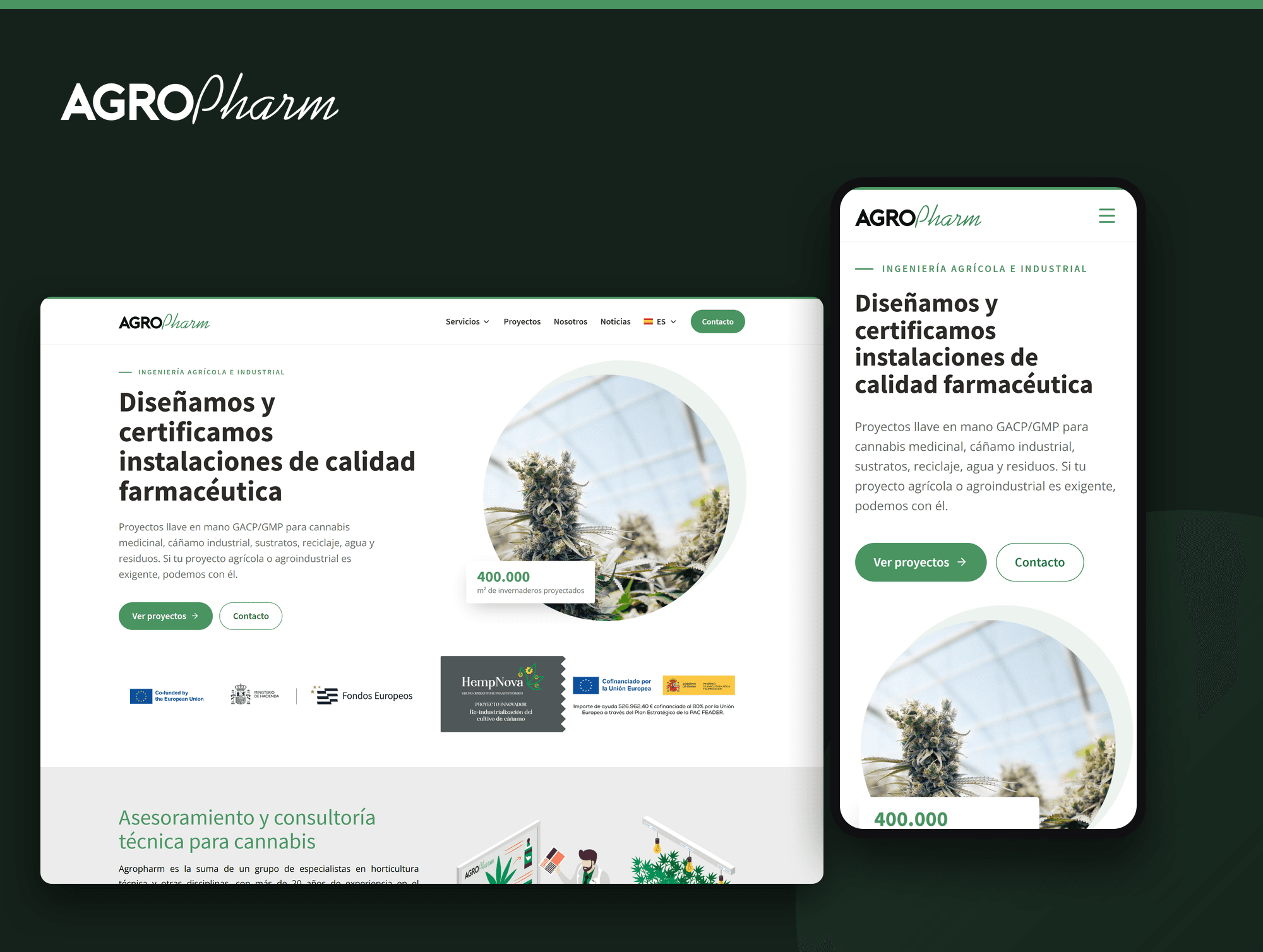
A custom corporate website that keeps the look it already
had and preserves every WordPress URL: pages, articles, categories, authors,
sitemaps and even the
?p=short links. - Five languages — English, Spanish, French, German and Portuguese — on a single domain, with hreflang only between translations that actually exist.
- Six service lines with their own pages, FAQs and a mega menu, and a contact form that arrives with the visitor's need already selected.
- Blog, projects and redirects editable per language from a back office, on top of its own API. Publishing updates the site instantly.
- Projects filterable by sector and status, plotted on a custom map of the Iberian Peninsula, with a detail page whenever the client chooses to say more.
How we built it
- Every redirect inherited from WordPress answers with a permanent 301, and each page's title and description were carried over word for word: the technology changes, not what Google already knows.
- Articles keep the anchors of their table of contents, because Google sends visitors straight to those fragments.
- Analytics does not load until the visitor accepts it, with Consent Mode v2, and the forms store proof of consent for every submission.
-
Next.js with incremental regeneration and a per-language
llms.txt: pages served pre-rendered that AI assistants can read too.